
Running a Sex Offender Check in Murray County
The official registry screen is the public search interface.
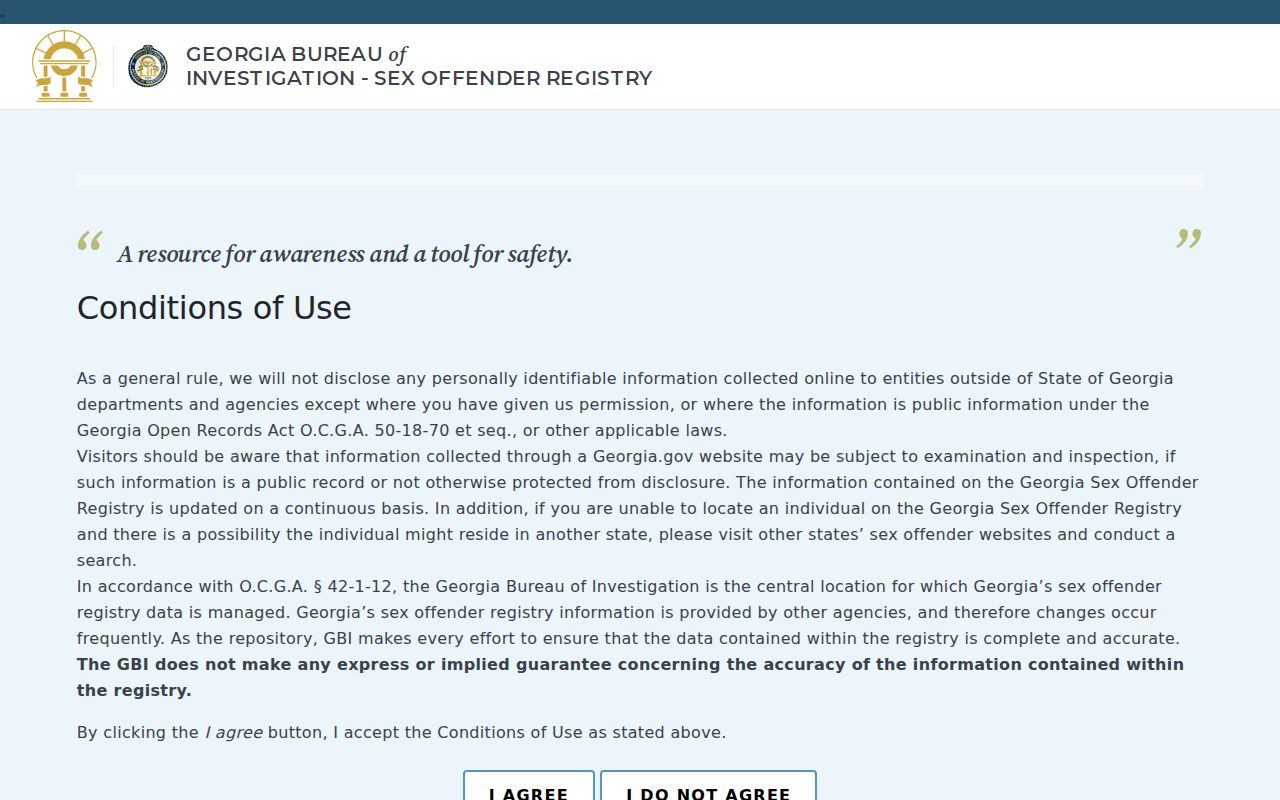
It is the correct starting point for Murray County results.
The GBI registry page explains the state data.
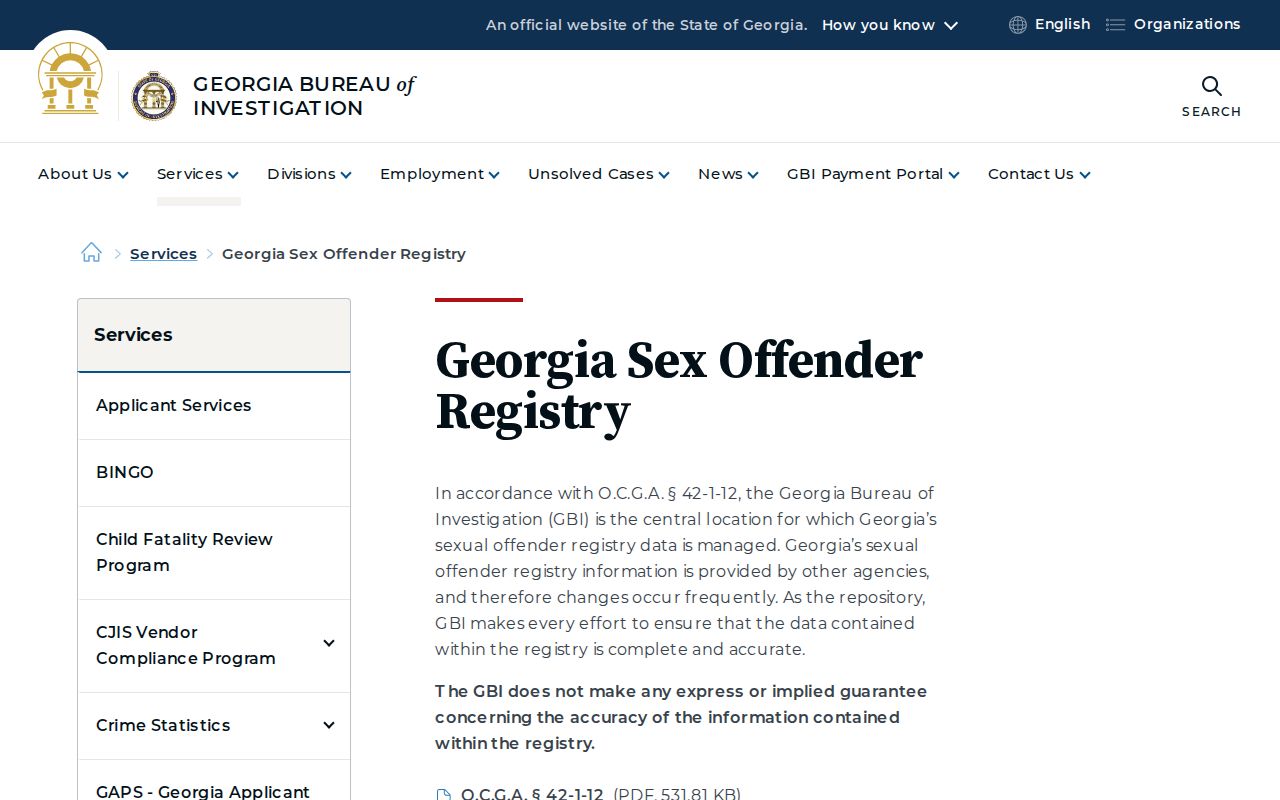
This guidance supplies context beyond a result list.
The GBI relief page describes the court route.
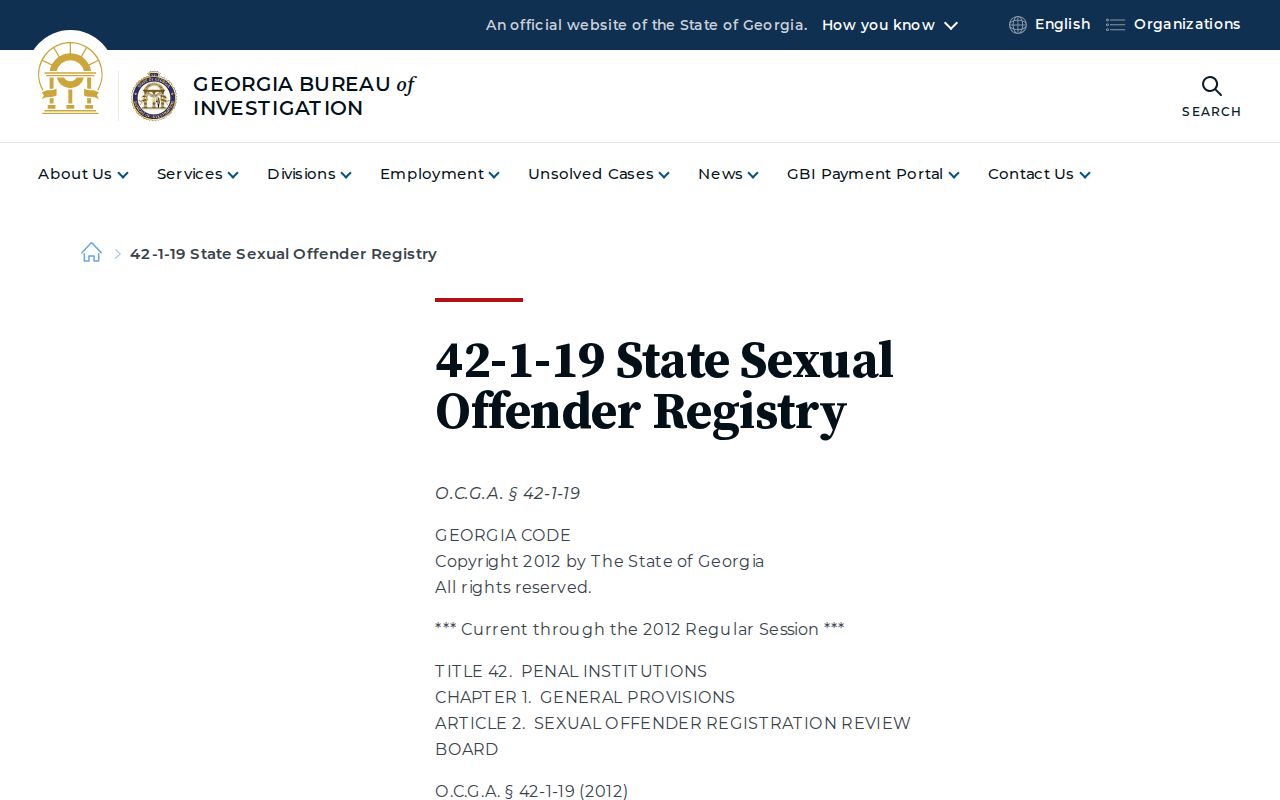
Relief is a legal proceeding, not a search correction.
The national registry search broadens geography.
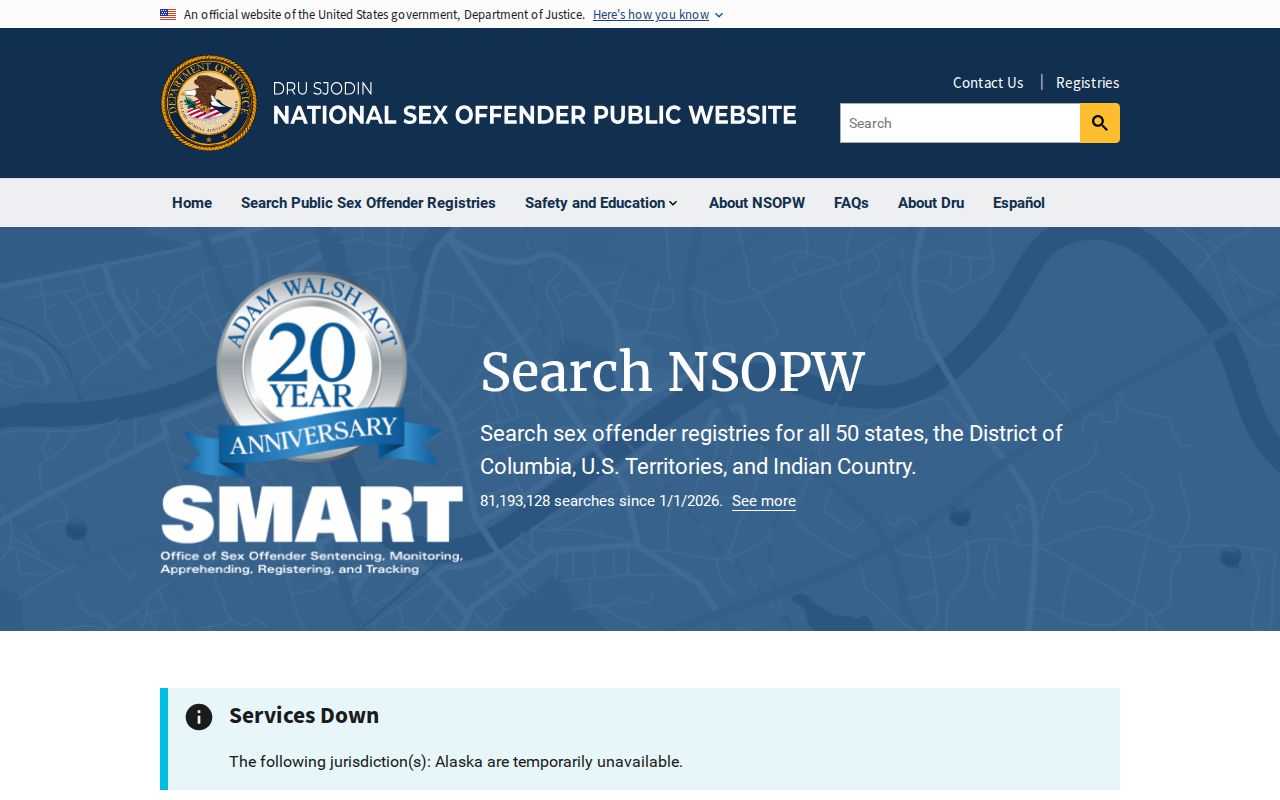
Georgia remains the detailed state source.
The official starting point is the Georgia Sex Offender Registry, managed by the Georgia Bureau of Investigation under O.C.G.A. §42-1-12. The site supports name and geography searches and receives source information from sheriffs and state agencies. Murray County residents do not need to rely on an unofficial people-search service. The state portal is the authoritative public search layer, and the Murray County Sheriff is the local office responsible for registration and verification work.
Begin with the most reliable facts available. Full name, spelling, approximate age, city, ZIP code, or county can help distinguish similar entries. A profile should be compared across several identifiers rather than accepted from a name alone. The registry is not a statewide court docket and does not replace a review of Murray County case files. Its public purpose is notice about people who have a current statutory registration duty.
Why Murray County Registry Results Change Daily
Georgia's public database updates daily because participating agencies continually submit new or changed information. A sheriff must report registrant changes to the state within two business days. That timing means a move, new work location, compliance update, or newly completed registration can appear after a prior search. The profile's registration and residence-verification dates help the reader judge when the displayed facts were last checked.
The GBI does not guarantee that every item is complete or error-free. A careful Murray County registry check records the search date and returns to the official portal when a decision depends on current location or status. It does not save and circulate a screenshot as if it were permanent proof. The public record remains live because the underlying duty and reported facts can change.
Searching the Georgia Sex Offender Registry
The registry requires acceptance of its conditions before the search screen opens. Those conditions explain that source agencies provide the data and that it changes continuously. Use the fewest filters needed at first, then narrow the list. A Murray County geographic search is useful for local awareness; a name search is better when checking a particular identity.
- Open the official registry and choose “I agree” after reading the conditions of use.
- Enter a first or last name, or select Murray County and add a city, ZIP, or address when useful.
- Review the list or map and compare aliases, year of birth, physical details, and address rather than matching on name alone.
- Open the full profile and read status, verification dates, classification, and offense details in context.
| Field or control | Type | Required | How to use it |
|---|---|---|---|
| First / Last Name | Text | No | Spelling matters; broaden the search if uncertain. |
| Offender Type / Status | Selection | No | Filters portal classifications or current status. |
| County | Dropdown | No | Select Murray for a county-wide view. |
| City / ZIP | Text | No | Narrows a geographic search. |
| Address | Text | No | Supports geographic or radius modes where offered. |
| Search / Clear / Map / List | Controls | Not applicable | Run, reset, or change the result display. |
A Missing Murray County Result Is Not Proof
An empty search can have several explanations. A name may be misspelled, an alias may differ, or a new registration may not yet have reached the public display. A person may fall outside the statute's coverage, may have completed qualifying first-offender treatment, or may be deceased. Geography filters can also hide a record when the current address is outside Murray County.
Try a wider name search, remove optional filters, and use the National Sex Offender Public Website if the relevant place may cross state lines. NSOPW federates participating public registries, while the Georgia page supplies the more detailed state format. Neither source should be stretched into a claim about people who do not appear. For suspected noncompliance, use the official tip route or contact law enforcement instead of confronting anyone.
What a Murray County Registry Profile Shows
A Georgia public profile combines identity, physical description, location, registration status, and offense history. The precise fields depend on what was collected and is public. The format may show a submitted photograph and its date, aliases, year of birth rather than a full birth date, primary or last-known address, and work, school, or vehicle data where the law permits.
| Name and Aliases | First, middle, last, suffix, and reported alternate names. |
|---|---|
| Photo and Physical Description | Photograph, sex, race, year of birth, height, weight, hair, eyes, and reported marks. |
| Registered Address | Primary or last-known street address and county, plus other public location fields. |
| Offense Information | Conviction date, state or jurisdiction, and offense description. |
| Risk Classification | Leveling information and whether the person is identified as a sexually dangerous predator. |
| Registration Status | Registration and residence-verification dates, plus absconder or compliance indicators. |
A profile is not a narrative of the whole underlying case. It may omit motions, plea terms, evidence, and other details held by the court. Readers seeking those materials should consult the Murray County criminal court case file rather than infer them from a short offense line.
The 72-Hour Rules for Murray County Registrants
Georgia generally requires in-person registration with the county sheriff within 72 hours of release, placement, or entry into the state when the statute applies. A registrant must maintain required information in each county of residence or where the person sleeps. Changes to covered information ordinarily must also be reported within 72 hours.
Annual renewal occurs in person during the 72 hours before the registrant's birthday and includes a new photograph and fingerprints. A person classified as a sexually dangerous predator has an added reporting point six months after the birth month. Failure to register, knowingly giving false information, or failing to complete birthday reporting can be a felony under O.C.G.A. §42-1-12(n). These duties explain why the sheriff's local verification and the GBI's daily publication are connected but not simultaneous.
Registration Requirements and Levels in Georgia
Georgia labels describe assessed risk, not the federal shorthand of automatic ten-year, 25-year, and lifetime tiers. Registry duty generally continues under §42-1-12 unless statutory relief applies. Annual birthday verification is the usual baseline, while a sexually dangerous predator may face enhanced requirements. A label alone should never be used to calculate a release date.
| Classification | Meaning and duration | Verification |
|---|---|---|
| Level I | Low assessed likelihood of a future dangerous offense; duty follows Georgia law and any court relief. | Generally annual in-person birthday renewal. |
| Level II | Intermediate risk assessment; not a promise of a 25-year cutoff. | Generally annual in-person birthday renewal. |
| Sexually Dangerous Predator | Highest board classification; enhanced monitoring may apply and duty ordinarily continues unless relieved. | Annual renewal plus an additional six-month report. |
A Murray County Map Pin Does Not Prove a Violation
Georgia residency and presence restrictions in O.C.G.A. §§42-1-15 and 42-1-16 can depend on the offense, conviction date, location type, and other case facts. A map's apparent distance from a school, child-care site, park, or other place does not by itself establish unlawful residence. Grandfathering and the date a restriction became applicable may matter.
Use the registry map for awareness and location context, not amateur enforcement. If an address appears wrong or a status raises concern, send the information through the portal's tip function or contact the Murray County Sheriff. The proper agency can compare registration records with facts that a public map does not show.
Murray County Superior Court Registry Relief
O.C.G.A. §42-1-19 provides a court process for some people seeking release from registration. The person generally must have completed imprisonment, parole, supervised release, and probation. One route may involve ten years after sentence completion; another may involve a Level I classification. Exact eligibility turns on statutory criteria and the record of the case.
A qualifying petition is filed in Superior Court, and the court considers whether the person poses a substantial future risk under a preponderance standard. A denial ordinarily prevents another filing for two years. This is not an automatic administrative deletion from the GBI website. Anyone assessing eligibility should read the current statute and official GBI relief guidance and obtain advice suited to the case.
Lawful Use and Murray County Community Safety
The registry exists for lawful awareness and safety planning. It is not a license to threaten a registrant, contact a household, damage property, or organize vigilantism. GBI specifically warns users against harassment and misuse. Suspected absconding or inaccurate information belongs with the sheriff or GBI registry staff, whose published contact number is 404-270-8399.
Use registry information lawfully: Harassment, threats, intimidation, or criminal misuse of Georgia Sex Offender Registry information can lead to prosecution. Report concerns to the Murray County Sheriff or GBI instead of confronting anyone.
Community awareness is strongest when the record is read precisely. Check the date, compare identifiers, distinguish a risk classification from a sentence, and avoid claims the profile does not support. That approach protects neighbors while respecting the limits written into Georgia's public system.